
Abdiaziz Hassan Nur1*, Sharmake Mohamed Ahmed2
, Sharmake Aden Said3
Abstract Review Article
East Africa, a region of immense ecological and socio-economic diversity, is one of the world’s most vulnerable areas
to climate change. This comprehensive review synthesizes the existing body of knowledge on historical and projected
trends in temperature and rainfall variability across the region, including Somalia, Kenya, Ethiopia, Uganda, Tanzania,
Rwanda, and Burundi. Utilizing a qualitative literature review methodology, this study analyzes data from peer-reviewed
articles, institutional reports from organizations like the IPCC, WMO, and FAO, and national climate policy documents.
The findings reveal a significant and accelerating warming trend across East Africa, with mean annual temperatures
having increased at a rate faster than the global average, particularly in recent decades. Projections indicate a further
rise of 1.5°C to over 4°C by the end of the century, depending on global emissions scenarios. This warming is
accompanied by a marked increase in the frequency and intensity of extreme heat events. Rainfall patterns are becoming
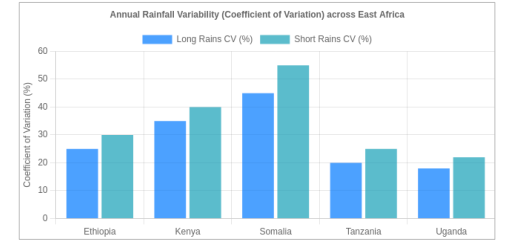
increasingly erratic and unpredictable, characterized by high inter-annual and seasonal variability. The region’s bimodal
rainfall system, comprising the “long rains” (March-May) and “short rains” (October-December), is experiencing
disruptions in onset, duration, and intensity. While long-term mean precipitation projections show high uncertainty, a
consensus exists on the intensification of extreme events: more frequent and severe droughts, often linked to La Niña
and negative Indian Ocean Dipole (IOD) phases, and more intense, concentrated rainfall leading to devastating floods,
often associated with El Niño and positive IOD phases. These climatic shifts are causing significant impacts, including
glacier retreat on East Africa’s iconic mountains, water level fluctuations in the Great Lakes, and severe disruptions to
agricultural productivity and pastoral livelihoods. The review concludes that the combination of rapid warming and
heightened rainfall variability constitutes a severe threat to the region’s food security, water resources, and socioeconomic stability. Recommendations focus on strengthening regional climate information services, investing in
transboundary climate-resilient infrastructure, promoting adaptive livelihood strategies, and integrating climate risk into
all national and regional development planning.
Keywords: East Africa, Climate Change, Temperature Trends, Rainfall Variability, Drought, Floods, Long Rains, Short
Rains, ENSO, Indian Ocean Dipole, Climate Projections