Abstract
Land degradation is a critical and accelerating environmental crisis in Somalia,
undermining the nation’s fragile economy, food security, and social stability. This
comprehensive review synthesizes the causes, patterns, and impacts of soil
degradation and assesses the current state of sustainable land management (SLM)
practices. Drawing on a wide range of academic literature, institutional reports, and
policy documents, the study employs a qualitative literature review methodology.
The findings reveal that land degradation, affecting an estimated 27-30% of the
country’s territory, is driven by a combination of direct and indirect factors. The
primary direct drivers include unsustainable agricultural practices, overgrazing, and
widespread deforestation, particularly for charcoal production, which clears an
estimated 73,000 hectares annually. These are compounded by indirect drivers such
as poverty, population pressure, weak governance, and the impacts of climate
change, including recurrent droughts. The consequences are severe, manifesting as
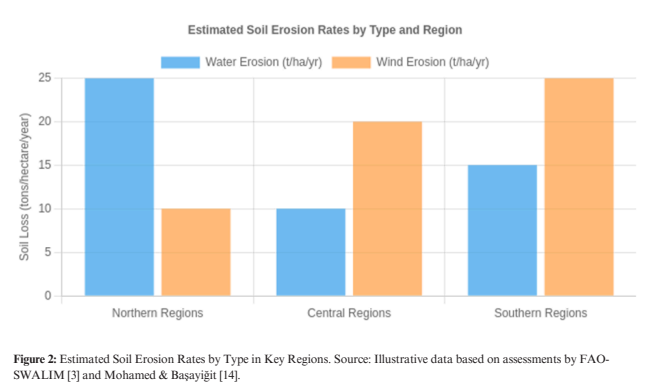
extensive soil erosion, loss of soil organic carbon, declining land productivity, and
increased salinization in vital river basins. These biophysical impacts translate into
significant socio-economic costs, including reduced crop yields, diminished livestock
productivity, and an estimated annual economic cost of land degradation that runs
into hundreds of millions of dollars. In response, Somalia has established policy
frameworks like the Land Degradation Neutrality (LDN) Target Setting Process
and the National Rangeland Management Strategy. However, the adoption of
SLM practices such as agroforestry, soil and water conservation, and rotational
grazing remains low and fragmented. This review concludes that a paradigm shift
from reactive interventions to a proactive, integrated landscape management
approach is urgently needed. Recommendations focus on strengthening
institutional frameworks, scaling up investment in SLM, enhancing communitybased natural resource management, and creating an enabling environment for
sustainable livelihoods to combat desertification and build a resilient future for
Somalia.