

Abdullahi Mohamud Adam,
Abdinasir Mohamed Yusuf,
Ilham Yahya Amir,
Omar Abdi Arab &
Omar Aweis Ali
Abstract
Background
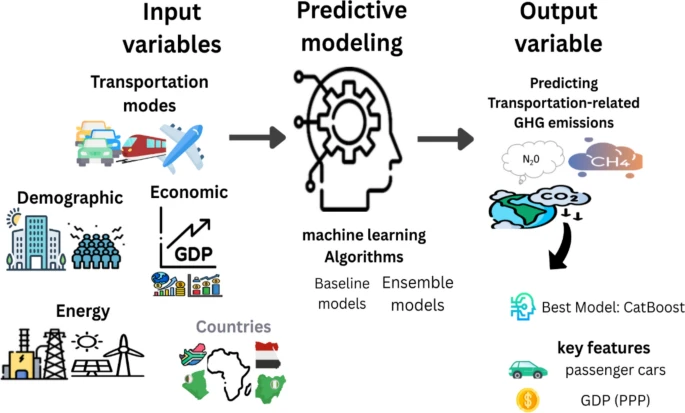
Transportation plays a pivotal role in global economic activities, facilitating mobility, trade, and sustainable development. However, it is also responsible for 15% of global greenhouse gas (GHG) emissions, with rapid urbanization and economic growth in Africa expected to further intensify these emissions. South Africa, Egypt, Nigeria, and Algeria together account for over 50% of Africa’s total emissions, emphasizing the need for detailed analysis and effective policy interventions. This study aims to predict GHG emissions from the transportation sector in these top-emitting African countries by analyzing demographic, economic, energy-related, and transportation-specific factors. Data from 1995 to 2022 were sourced from the World Development Indicators (WDI) and the International Organization of Motor Vehicle Manufacturers (OICA). Seven machine learning models were tested, including ordinary least squares (OLS), ridge regression (RR), categorical boosting (CatBoost), light gradient boosting machine (LightGBM), histogram-based gradient boosting (HGB), random forest (RF), and bagging regressor (BR). The models were assessed using fourfold cross-validation and performance metrics, such as mean absolute percentage error (MAPE), relative root mean square error (rRMSE), and R2.
Results
Results show that CatBoost demonstrated superior performance, achieving an R2 of 0.960, MAPE of 4.9%, and rRMSE of 6.7%. Feature importance analysis identified passenger cars in use and GDP (PPP) as the most significant contributors to GHG emissions from transportation. The findings further reveal that all evaluated factor categories, including demographic, economic, energy, and transportation-specific, exert a significant impact on GHG emissions from transportation, with transportation-specific factors exhibiting the greatest influence. Moreover, when comparing the relative impact of nations on the predictive model, Egypt (EGY) was found to have the highest influence among countries analyzed.
Conclusions
These findings provide critical insights for policymakers in Africa, particularly in the top-emitting countries, to revise energy investments and design targeted strategies for mitigating transportation-sector emissions.