
Abstract
Agriculture is a major contributor to non-CO2 greenhouse gas emissions, mainly
methane (CH4) and nitrous oxide (N2O), whose global warming potentials (GWP) are
28 and 265 times higher than that of carbon dioxide (CO2), respectively. This study
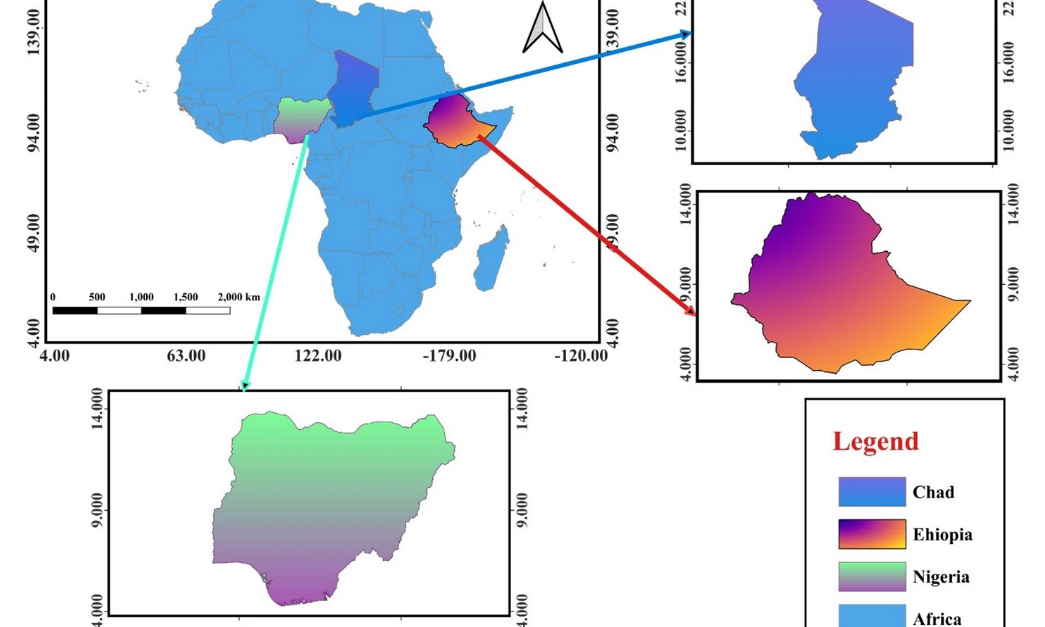
predicts CH4 and N2O emissions from agriculture in Ethiopia (ETH), Chad (TCD), and
Nigeria (NGA) using time series data from 1993 to 2022 sourced from FAOSTAT and
the World Bank, with projections extending to 2050. Agricultural-environmental, and
economic indicators were incorporated into the analysis. A stacking ensemble model
combining Random Forest, XGBoost, CatBoost, and Gaussian Process Regression was
applied, along with time series models (Prophet and LSTM) for future forecasting. The
stacking model achieved accuracies of 0.986, 0.982, and 0.945 for ETH, TCD, and NGA,
respectively. SHAP analysis showed that agricultural land area and manure nitrogen
content were the main factors influencing emissions across the three nations.
Prophet forecasts indicated a steady rise in emissions through 2050, likely driven by
livestock intensification and land-use expansion. These findings highlight machine
learning’s effectiveness in improving agricultural emission estimates and guiding
data-driven mitigation strategies, offering insights into advancing climate-smart, lowemission agriculture in Africa.